Wedding Processional Order UK: Who Walks Down the Aisle
Everyone in your family has an answer and half of them are describing an American film. The traditional UK order, the modern variations, and the timing nobody plans for.
This sounds like a trivial question right up until you ask it out loud in front of your family. Who goes first? Everyone has an answer, roughly half of them contradict each other, and the most confident person in the room is usually describing a wedding they saw in an American film.
So, the short version for a UK wedding. The groom is already at the front before anything begins. Guests take their seats, the bride's mother is shown to hers last, and then the procession starts: any children first, then the bride on her father's arm, and the maid of honour and bridesmaids walking behind her. That last detail is the one people get stuck on, because in the American order the bridesmaids lead and the bride comes last. Both look wonderful. Neither is a rule anybody can actually hold you to.
The traditional UK order, start to finish
- Ushers seat the guests, bride's family and friends on the left, groom's on the right, as you look towards the front.
- The groom and best man take their places at the front on the right, either walking in or slipping through a side door.
- The ushers finish seating people and sit down themselves.
- The groom's parents are shown to the front row on the right.
- The bride's mother is seated last, front row on the left. That is the signal that the ceremony is about to start.
- Flower girls and page boys go in first, if you have them.
- The bride follows, traditionally on her father's arm.
- The maid of honour walks behind the bride, then the bridesmaids, in pairs if there are enough of them.
There is a practical reason the attendants walk behind rather than in front. They are the people who catch the train, straighten the veil and take the bouquet off you at the top of the aisle, and they cannot do any of that from six rows ahead. The older explanation is better fun: bridesmaids were once dressed to resemble the bride so that any evil spirits in attendance would be confused about which one to curse. As job descriptions go, "decoy" is quite a lot to ask of a friend.
Why does everyone online say the bridesmaids go first?
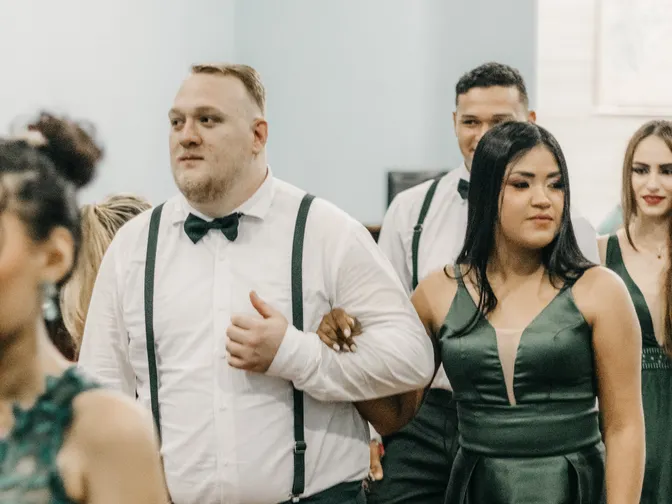
Because most of the internet is American, and the American processional genuinely is the other way round: officiant, then grandparents, then parents, then groomsmen, then bridesmaids, then the maid of honour, then the ring bearer and flower girl, and finally the bride. It is a longer, more choreographed entrance, and it has been on our screens for forty years, which is why your cousin is so sure about it.
Plenty of British couples now use that version, and no registrar or vicar will stop you. One practical note if you do: someone still needs to be responsible for your dress at the top of the aisle, and it is better agreed in advance than solved by three people lunging at your train at once.
Does the groom walk down the aisle?
Traditionally, no. He is already standing at the front, right-hand side, having arrived early and been quietly panicking for twenty minutes with the best man. In a church he often comes in from a side door, which is why so many grooms describe their own entrance as "appearing".
That is changing, and we think for the better. Grooms increasingly walk the aisle properly: alone, with the best man, or on their mother's arm. A wedding where one person gets a musical entrance and the other gets a side door is not really telling the truth about the day. If you want it, take it.
Who gives the bride away, and does anyone have to?
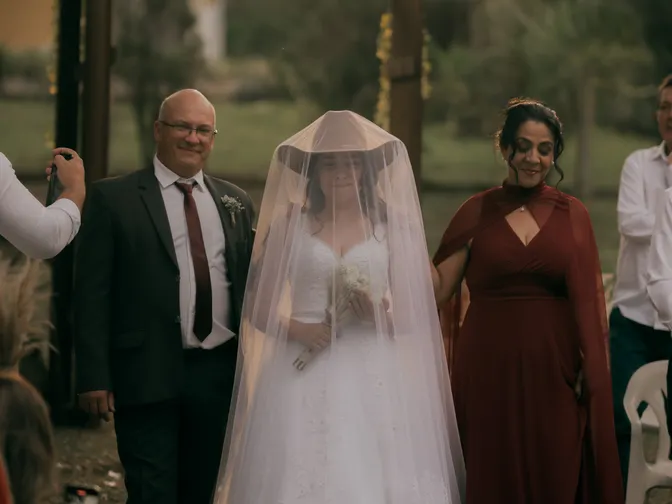
A father is the default in most people's heads, and for a great many weddings it is still exactly right. It is not compulsory, and it is not always simple. If your father is not around, or is around and not welcome, or if there are two fathers with a claim, you have more options than tradition suggests. Both parents, one on each arm, is now common and looks lovely. A mother, a brother, a stepdad, a grandmother, your oldest friend, all fine. Walking in on your own is fine. Walking in together as a couple, which quietly makes the point better than any of the alternatives, is also fine.
The Church of England's Common Worship service treats the giving away as optional, and offers a version where the minister instead asks the parents of both the bride and the groom to affirm their support. Worth knowing before anyone assumes. In a civil ceremony there is no giving away at all in the legal sense, so whatever you do at the top of the aisle is choreography rather than procedure. Ask your vicar or your registrar what their wording allows and build the walk around that, not the other way round.
Where do the children go, and will they cooperate?
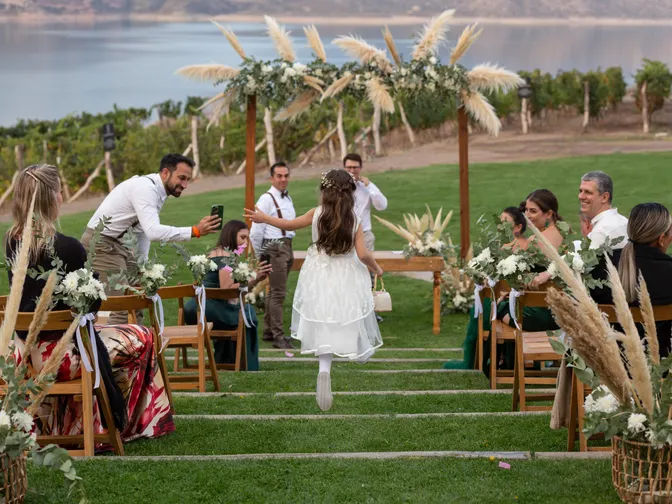
Directly in front of the bride, which is the traditional position and also the sensible one, because it means there is an adult immediately behind them for the entire journey. Give every child one job and one only. Petals, or a sign, or holding a hand. Two jobs is one too many.
Under about three, assume nothing will happen as described and decide now that you are fine with it. Seat whoever the child will run to in the front row on the aisle, tell your photographer they are in the procession, and let it be the story people tell afterwards. The weddings where this goes wrong are the ones where somebody had a plan and no plan B. Write the running order down somewhere you can both see it, alongside the rest of the day, which is exactly the sort of thing our free wedding planner is for.
Which side does each family sit on?
Facing the front: bride's side on the left, groom's on the right. That is the convention in a Church of England ceremony and most civil ones follow it out of habit. It comes apart the moment one family is much bigger than the other, which is often, and a room split forty to a hundred looks worse than no convention at all.
The fix everyone has landed on is a small sign at the entrance saying to pick a seat rather than a side. It works, it takes the pressure off your ushers, and it saves the arithmetic you have already done once while building the guest list. Keep the front row or two reserved for immediate family either way, and make sure the ushers know by name who those seats belong to.
Two brides, two grooms, or no procession at all
There is no established order here, which is a gift rather than a problem. The three shapes we see most: walking in together from the back, hand in hand, with everyone already seated. Each of you walking separately, one after the other, with your own music and your own people. Or both of you starting from opposite ends, meeting in the middle, and walking the last stretch together, which is theatrical and almost always makes somebody's mother cry.
And if the whole idea leaves you cold, skip it. Small ceremonies often have no aisle to speak of, and standing at the front welcoming people in as they arrive is a lovely way to begin. It also removes an entrance that a lot of people quietly dread and almost nobody admits to dreading.
The bit nobody plans: how long any of this takes
If you are marrying at a register office or a licensed venue in England or Wales, the registrar has to interview you both before the ceremony, separately or together, and offices generally ask you to be ready twenty to thirty minutes before your slot. Check the exact figure with yours. It matters because it quietly kills the tradition of the bride arriving fashionably late: your registrar has ceremonies booked after yours, and the interview is not optional. Ten minutes of drama at the gates costs you ten minutes of your own wedding.
The walk itself is shorter than people expect. A processional usually runs three to four minutes end to end. One person takes thirty to forty-five seconds down a typical aisle, and the spacing that looks right is roughly ten to fifteen seconds apart, or simply starting when the person ahead reaches halfway. Aisle lengths vary enormously between venues, so it is worth adding to the list of things you ask on the viewing and then telling whoever is playing your music, because a song that runs out with two bridesmaids still walking is a silence people remember.
And afterwards: who walks back out first?
The recessional is the processional in reverse, and it is the easy one because by then everyone is delighted and nobody is nervous. The two of you go first, once the maid of honour has handed your bouquet back and checked your train. Then the children, then the maid of honour and best man, then the attendants in pairs, then the bride's parents, then the groom's, then everyone else from the front rows backwards.
One modern detail worth knowing in England and Wales: since May 2021 there is no register book to sign. You sign a marriage schedule instead, it is registered electronically, and your certificate arrives in the post rather than in your hands on the day. Up to four parents can be named on it, which is a welcome change for anyone with a stepparent they want on the paperwork. The signing still happens before you walk out, and your photographer will still ask you to pretend to do it again.
Write the order down, then tell three people
Almost every processional that goes wrong goes wrong for the same reason: it lived in one person's head. Put the order in writing, share it with your ushers, your officiant and whoever is running the music, and keep it with the rest of your day's running order in one place you can both open on a phone. That is the whole job our free planner does, and setting it up takes a couple of minutes. Then stop optimising it. Nobody has ever left a wedding talking about the spacing between the bridesmaids.
Aisle order questions couples ask us
Who walks down the aisle first at a UK wedding?
The flower girls and page boys go first, if there are any, followed by the bride on her father's arm, with the maid of honour and bridesmaids behind her. Everything before that is not really the procession: the groom and best man are already at the front, and the bride's mother is the last guest to be seated, which is the cue for the music to change.
Does the bride walk before or after the bridesmaids?
In the traditional British order the bride walks in front and her bridesmaids follow, so they can carry her train and sort out her dress and veil when she reaches the front. In the American order the bridesmaids go first and the bride enters last. Plenty of UK couples now use the American version and no officiant will object, but decide in advance who is taking charge of the dress.
Does the groom walk down the aisle?
Traditionally he does not. He waits at the front on the right-hand side, often having entered through a side door with the best man. More grooms now choose to walk the aisle, either alone, with the best man, or on their mother's arm, and there is nothing stopping you. It is a nice correction to a day where one person gets an entrance and the other gets a side door.
Which side does the bride's family sit on?
Looking towards the front, the bride's family and friends sit on the left and the groom's on the right. It is convention rather than a rule, and it falls apart when one side has three times as many guests as the other. A sign asking people to pick a seat, not a side, solves that neatly and saves your ushers a lot of quiet diplomacy.
Do you have to be given away by your father?
No. Both parents together, a mother, a stepfather, a sibling, a close friend, or nobody at all are all perfectly normal now, and walking in as a couple is increasingly popular. The Church of England's Common Worship service treats the giving away as optional and offers an alternative that involves both sets of parents, and a civil ceremony has no giving away in the legal sense at all.
What order do people walk out after a wedding ceremony?
The couple leave first, then any children, then the maid of honour and best man, then the bridesmaids and groomsmen in pairs, then the bride's parents, then the groom's parents, then guests from the front rows backwards. In England and Wales the marriage schedule is signed before this, replacing the old register book since May 2021.
Start your plan, free
Add your date and watch the countdown begin. The checklist, budget and guest list are waiting.
Create your free accountPhoto by Alexander Mass via Pexels. Additional images via Pexels.
← Back to The Planning Notes